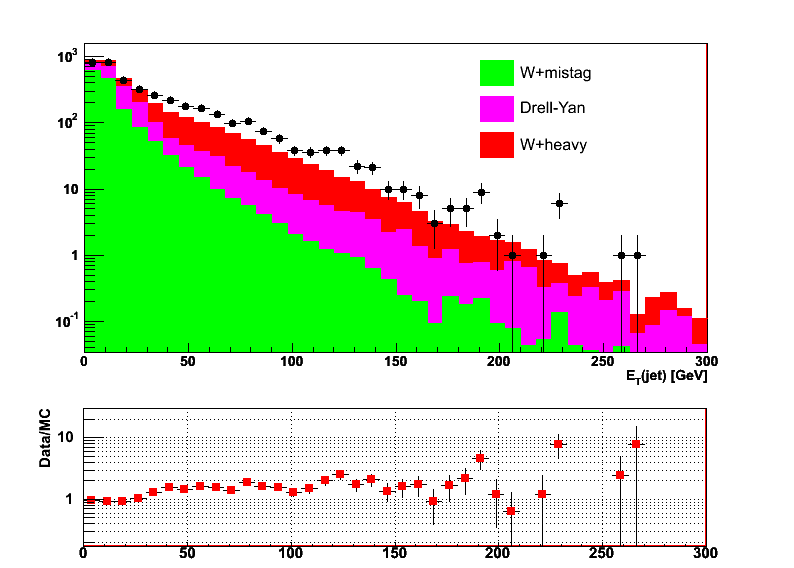
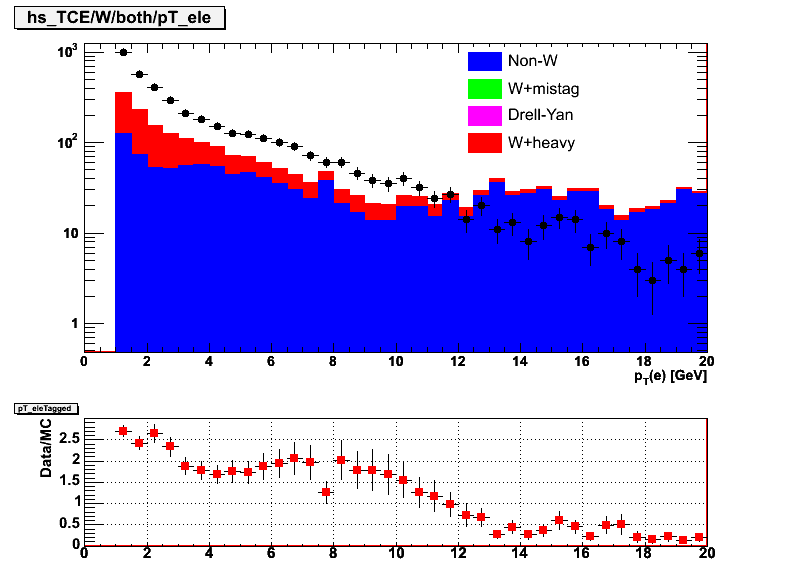
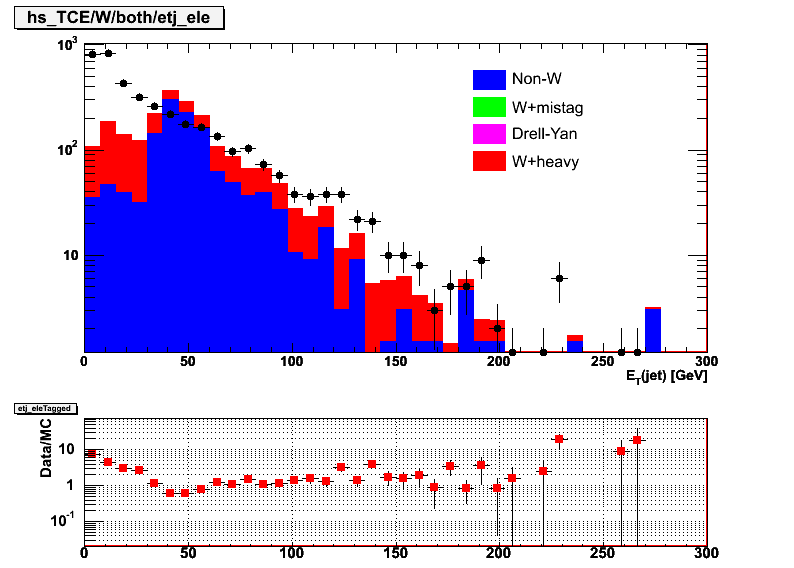
I’ve improved the fits for the SE parameterization. Here are the plots.


———————————————————————————


-Scott
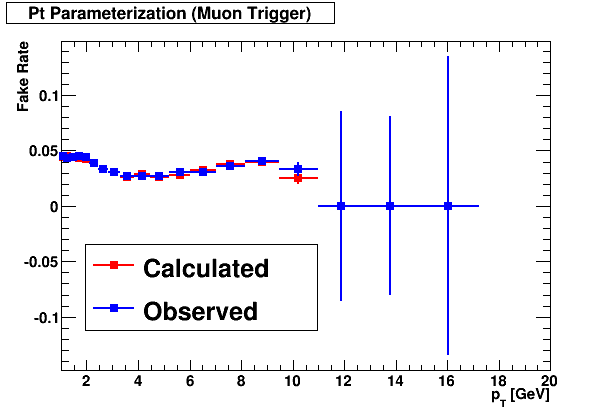
To parameterize the new likelihood, I tried to take the correlations into account more carefully than last time. I made three bins each of Pt, Eta, and Isolation, then fit the fake rate dependence on each of those variables in each of the 27 bins. This parameterization models the fake rate in the muon-triggered sample quite well:

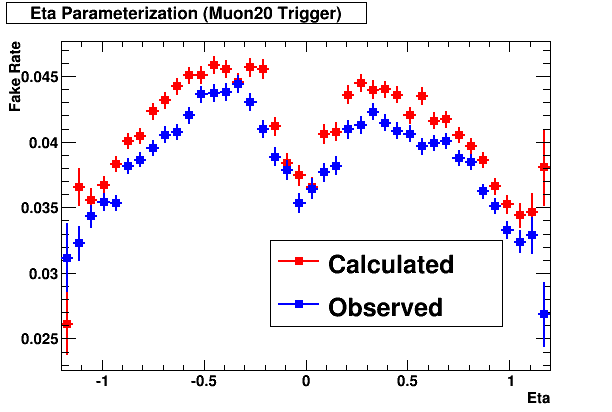

However, the Jet50 sample looks very different:
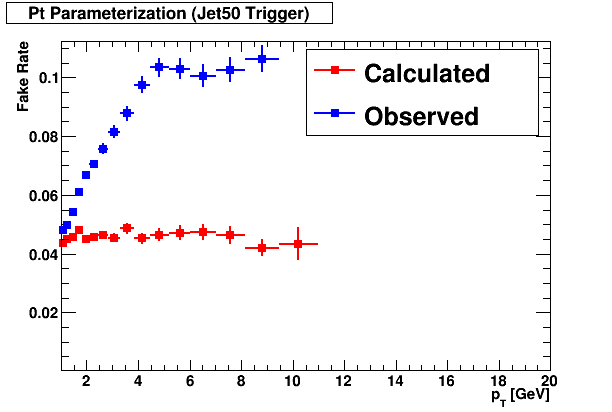


I’ll examine which variables are causing this difference, and have something by the Monday meeting.
-Scott
Edit: the signal-only likelihood also has this problem, but it’s less dramatic in a way. The fake rate is still off by a factor of two at higher pT, but it’s a factor of two of a smaller number. (In the signal-only likelihood, the fake rate is higher at low pT and lower at high pT.)
I’ve finished retraining the likelihood with the new CP2 radius and more of the Eta correlations added in. Here are some plots.
First, here’s the efficiency and fake rate as a function of pT, eta, and isolation for a likelihood cut of 0.9:

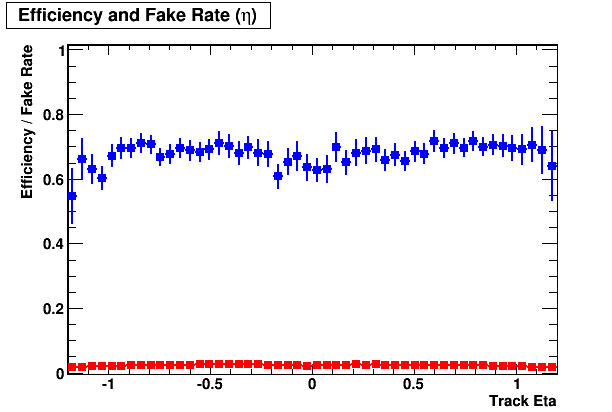
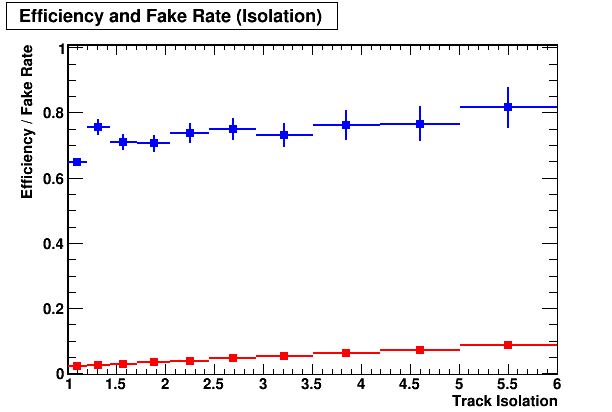
The strange eta effect is gone, and the efficiency is extremely high for high-pT candidates. (In this case, high-pT means “above about 4 GeV”.) This high efficiency in the high-pT case remains even at stricter likelihood cuts.
Here’s a plot of the low-pT (below 1.25 GeV) efficiency and fake rate as a function of the likelihood cut:

Also, here’s a comparison of the efficiency vs. fake rate for the “signal vs. background” likelihood (smooth lines) and the “signal” likelihood (many points). The red is the 1 < pT < 1.25 range, green is 2 < pT < 2.5, blue is 4 < pT < 5, and purple is pT > 8. As expected, the “signal vs. background” likelihood performs better.

-Scott
I figured out why the CPR response varies so much with Eta. See the recent posts about the Eta effect in the electrons, and see this plot of Conversions/Generic tracks in E_{CPR} vs. Eta:

Here’s a high-resolution plot of CPR response vs. the extrapolated Z position of the track. This plot includes all tracks (after quality cuts) so we expect to see a MIP peak in the response:
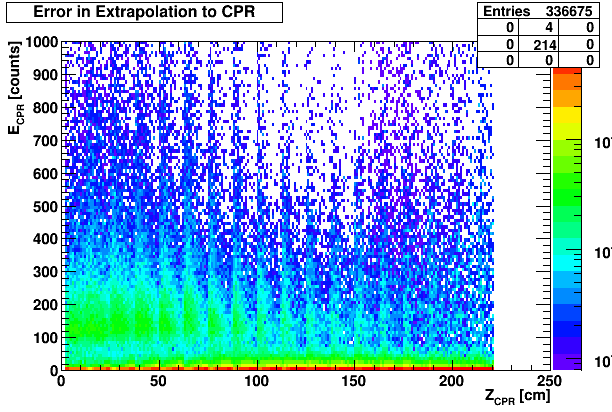
The MIP peak is clearly visible near the center of the detector, but is only visible along one edge of each pad near Z=100 cm. (The pads are 12.5 cm wide, as you can see in this plot.) It’s clear that the actual maximum of the response in the detector is at a higher Z than where the extrapolator puts the track. By Z=150 cm, we’re completely missing the energy in the detector. This Z range corresponds very closely to the Eta range in which we see the strange electron effect.
It should be relatively easy to fix the extrapolator to correctly find the CPRZ of the electron. A simple increase in the radius of the CPR should do it. This would also affect the E_CPR vs. X_CPR distribution, but it’s difficult to tell if the same problem exists there, the the CPR is only three pads wide in X:

Edit:
I changed the CP2 radius from 170.47 cm to 172.47 cm, and the effect goes away. I’ll rerun my soft electron stuff now, and we’re going to have to reprocess the ntuples to get the correct CP2 data in there.

-Scott
Using the tag and mistag rates that we have now, I have calculated the predicted number of W+soft dilepton events in the 1 fb-1 sample. The calculation is slightly different for the same and opposite flavor dilepton cases. We will show the dielectron case as the same-sign example.
| Lepton 1 | Lepton 2 | Normalization |
|---|---|---|
| el | el | R21(ej,ej)*N(ej)+R21(eDY,eDY)*N(eDY) |
| el | eh | R21(el,eh)*N(eh) |
| eh | eh | R21(eh,eh)*N(eh) |
The notation used is as follows
Below is the different flavor case.
| Lepton 1 | Lepton 2 | Normalization |
|---|---|---|
| el | ml | R21(mj,ej)*N(mj)+R21(mDY,eDY)*N(mDY) |
| el | mh | R21(el,mh)*N(mh) |
| eh | ml | R21(ml,eh)*N(eh) |
| eh | mh | R21(eh,mh)*N(mh) |
The results are below.
Continue reading Number of predicted and observed dilepton events in 1 fb-1
As we’ve talked about, there’s a strange effect in the soft electron eta distribution, with edges at about +/- 0.5 that make it look like a muon distribution:
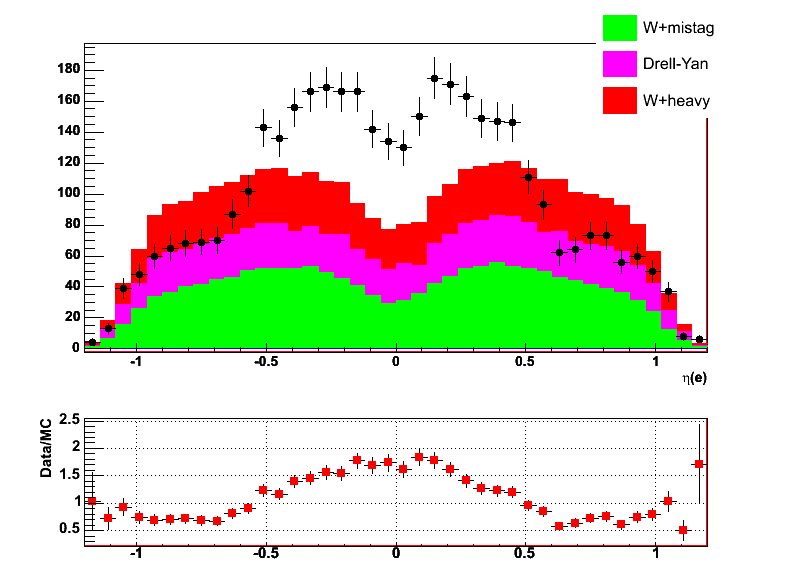
I’ve found out what the problem is: the CES response is different at different points in CesZ. Pasha’s 2D CES calibrations normalized the E_CES / P response to real electrons with respect to position, but the fakes have a different profile:


I neglected this correlation between E_CES and Z_CES in the likelihood, so we end up with more mistags (because more pions have a high E_CES) at low eta and fewer mistags at high eta, which is consistent with the distribution that we saw. I could retrain the likelihood to take this correlation into account, or just modify my MC parameterizations to try to make them agree with the data. The latter would take less time, so I’ll work on that now, but we really should actually fix it (and retrain the likelihood again) someday.
Edit: (7/7/10)
There’s another effect which also contributes: the fakes have a larger spread of their CES Delta Z when the tracks are at a higher eta:
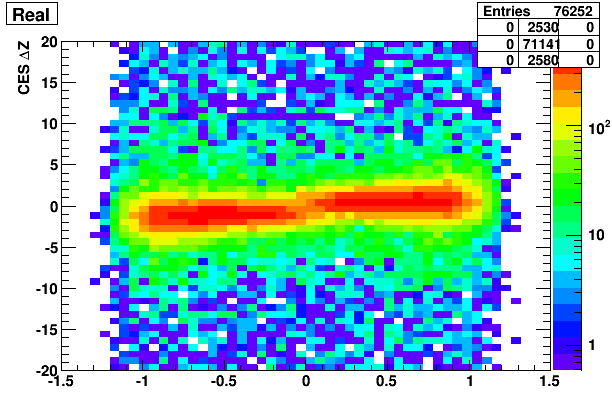

Again, the CES calibrations normalized this for real electrons, not for fakes. This is another effect that gives fewer mistags at high eta.
-Scott
We use the fit results below and apply additional DY muon rejection by cutting on events with muon triggers and:
TCE+1 soft electron
In the post before the previous one, I showed all the soft lepton fits using 3 components. Most of the fits did not converge. At the time, Scott suggested that this was because the templates did not use the high luminosity MC and thus had holes in it. I added the high lumi MC to the templates and there were still convergence problems. The solution was found by using the data-based mistag shape for the light template rather than W+jets MC. The corresponding fits are below. Note that the chisquare is not a real goodness of fit statistic because this is an event-by-event multidimensional fit.
Using the results of the 3 component fit below, we make stacked histograms for the exclusive single lepton bin.
I thought the fits would perform better if I combined the bottom and charm templates. I also set the amount of Drell-Yan to 0 in the soft electron fits because it didn’t seem necessary to use it there. We expect less Drell-Yan because in the soft electrons because the second leg will be soft, nearly collinear with the trigger electron, and therefore knocked out by the trigger electron jet removal. Here are the results.


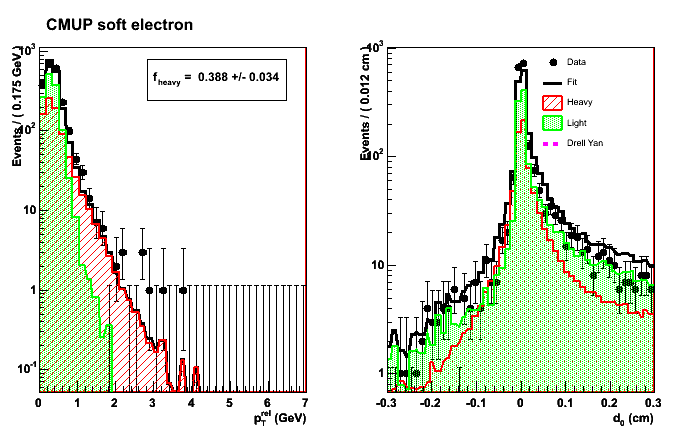

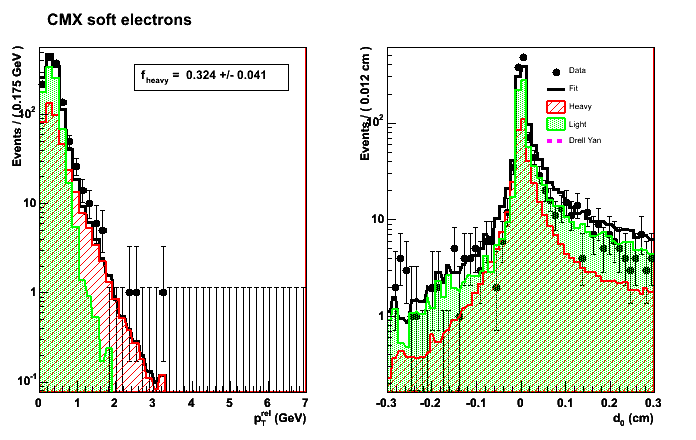
 The soft muon results with f(heavy)=0.5 are suspicious because that is the initial value of the parameter