Alpgen Cross Sections

Vadim pointed out to me today that the Alpgen cross sections for W and Z do not agree with the measured CDF values.  From J. Phys. G: Nucl. Part. Phys. (2007) 2457-2544 we have the measured values:

  • sigma(W)xBr(W->l nu)=2.749 +- 0.010 (stat.) +- 0.053 (syst.) +- 0.165 (lum.) nb
  • sigma(Z)xBr(Z->ll)=254.9 +- 3.3 (stat.) +- 4.6 (syst.) +- 15.2 pb

where the Z is measured for 66<116 GeV.  The corresponding Alpgen cross sections are

  • sigma(W)xBr(W->l nu)=2.067 nb
  • sigma(Z)xBr(Z->ll)=183.7 pb

where the Z is in the range 75<105 GeV.  Ignoring the difference in dilepton mass ranges for now, we obtain the following K-factors:

  • K(W)=1.33
  • K(Z)=1.39

The authors of the top dilepton cross section apply similar K-factors, as can be seen from comparing Table 6 in CDF 9400 with the top group MC webpage.

–Dan

The Plan

Carla, Scott, and I discussed what steps are needed to complete this analysis. We have come up with the following:

  • Validate and add soft muons to ntuple.
    • apply algorithm to signal MC to check modeling/expected signal efficiency
    • apply to JET20 with selections designed to minimize heavy flavor such as cuts on N(SECVTX) or |d0|. Check the fake rate obtained from lambda’s on jets. Obtain correction factors to take correlated punch-through into account.
    • Get inclusive Z/W rates correct.
      • possibly check R-ratio.
      • Implement QCD scheme.
        • develop anti-electron MET template. Use inverted electron selection or obtain from jet sample.
        • fit MET using electroweak+anti-electron templates. Verify fractions/shapes on mT distribution.
        • Validate modeling in control regions.
          • invert cluster likelihood selection, relax MET cut, invert hT.
          • Make more signal MC at various m(H), m(a).
          • Open the box on 1 fb-1 and look in signal region.
            • if good, go for the whole dataset

          If others have more steps or details to add, please leave comments on this post.

          –Dan

          Soft Muon Efficiencies / Fake Rates

          Here are the final soft muon efficiency / fake rate plots.  I am not comparing these numbers to the ones found by the B group, since I’m using different definitions than they did:  I’m counting muon candidates by tracks instead of by muon objects.  The B group was finding a muon object, checking whether its track could be identified as a muon or hadron, and then applying the likelihood.  I’m checking all tracks to identify them as a muon or hadron.  If a track is identifiable by a secondary vertex fit, but it doesn’t have a muon object, I give it a likelihood of -2.  Since most hadrons don’t leave a muon object in the detector, I get much better numbers than the B-group did.

          Continue reading Soft Muon Efficiencies / Fake Rates

          Inclusive Z and W Modelling

          As a first basic check of our background modelling, alpgen cross sections, whether I have made a massive mistake, etc., I look at inclusive Z’s and W’s in the CMUP (CMUP-CMUP in the case of Z’s) sample.  I do not have the QCD contribution included, but it should be negligible for the muons.  I also do not have dibosons, but their cross section is small.  I expect agreement in the ~5% range.  Instead I see the following,

          For W’s with the selection pT(CMUP)>20 GeV + MET(L5)>20 GeV : n(BG)= 238974, n(data)=425875.  Below is the corresponding transverse mass plot.
          Inclusive W transverse mass

          We are clearly missing a lot.

          For Z’s with the selection 2 CMUP with pT>20 GeV: n(BG)=4011 and n(Data)=6224.  Below is the dimuon invariant mass,
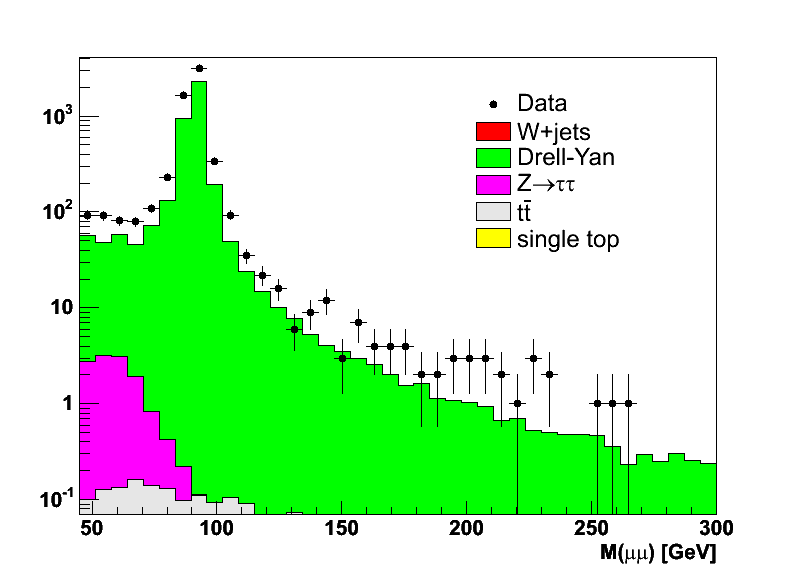
          Z dimuon invariant mass

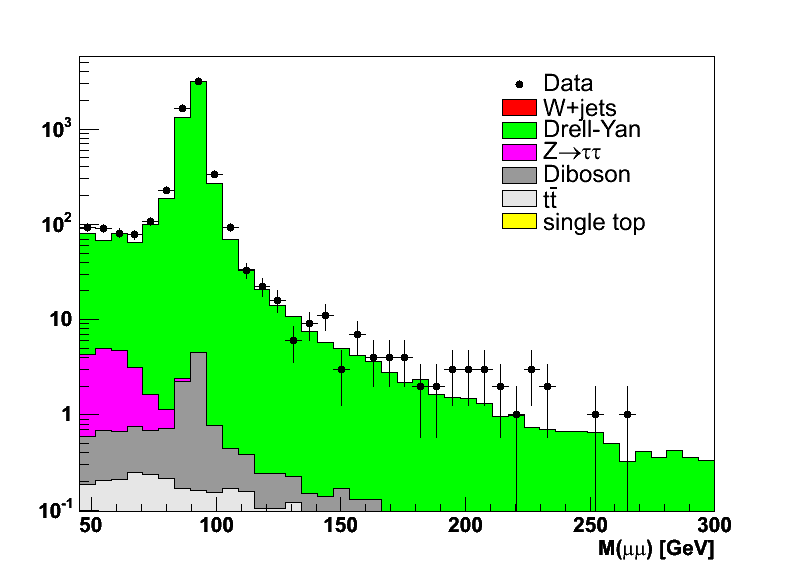
          I checked the njet distribution and the slope of the background and data are similar, but the data is high everywhere.  After some investigations, I see that I may not be selecting the primary vertex correctly and also that I am not saving all the PV information in my ntuple that I should be (quite stupid of me actually).  The next thing I need to do is reprocess all the ntuples to put this stuff in there.  I am beginning this job now.

          –Dan
          Soft Muon Efficiency / Fake Rates

          Here are the plots of efficiency vs fake rate for the soft muon code, separated by muon type.  The efficiencies and fake rates are similar to those quoted in CDF Note 7043, although the note did not give the Pt dependence.  I apologize for the low statistics in some of these categories.  Plots are below the fold.

          Update 6/8: Cleaner-looking plots (see bottom of post)
          -Scott

          Continue reading Soft Muon Efficiency / Fake Rates

          Delta Phi(Met) for muons in a control region

          I defined a control region similar to the one above as follows:

          • Met>20 GeV (L5 corrected)
          • Ht>100 GeV
          • Exactly 2 clusters satisfying anti-selection.

          I used L5 corrected met because I want to plot the dPhi between the met and clusters/leptons and it will be badly smeared if I don’t correct for jets. I only look at the muons because I expect them to be have less QCD background. The background prediction (excluding Z+jets, dibosons, and QCD) is 4933 events and we observe 5609 in 950 pb-1. The plots are below. Continue reading Delta Phi(Met) for muons in a control region

          NMSSM Higgs Search