Luminosity of available data

I have calculated the luminosity of the electron and muon data available after the application of the latest good run list for electrons and muons with silicon.  This good run list is for data through p21.  Note that because both of the triggers we are using (ELECTRON_CENTRAL_18 and MUON_CMUP18) are unprescaled, the luminosity of these 2 datasets under the same grl is almost completely identical.

Dataset Runs Periods L(electron) [1/pb] L(muon) [1/pb]
0h 190697-203799 1-4 363 363
0i 203819-228596 5-9 587 587
0j 228664-246231 10-13 945 945
0k 252836-254683 14-17 484 483
0m 261119-271047 18-21 1216 1216
Total 3595 3594

We are not including the 0d data because the CP2 is installed after that period. The luminosity of that dataset is 315(320) pb-1 for electrons(muons).

–Dan
More Validation of the Soft Muon Tagger

Here’s the work that I’ve done on validating the soft muon tagger.  I’ve taken four samples from data: muons from J/Psi, pions from K_s, kaons from D^0, and protons from Lambda.  The soft muon ID seems to work as expected, although the fake rate is higher than I’d like at low Pt.  Perhaps we could improve it by adding more likelihood variables (E_cal/P_trk ?) but that might be too much work for very little gain.

Continue reading More Validation of the Soft Muon Tagger

CES Calibrations: The Finale

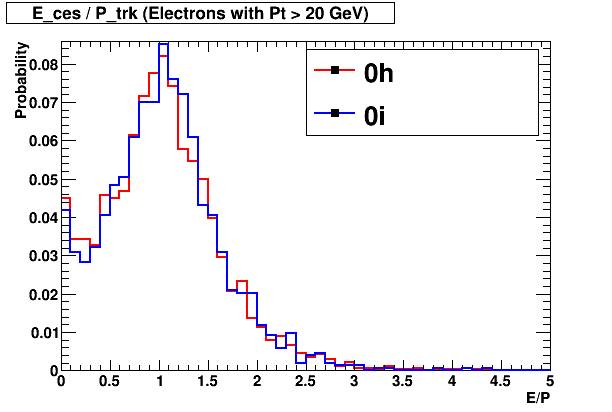
I met with Pasha today for a few hours and finally ironed out the last bugs from the CES calibrations.  We are now starting the process of calibrating the rest of the data. (periods 0j, 0k, and 0m)  Now that we’ve figured out the procedure, it should go relatively quickly; I estimate a week to get through the rest of the data.  Just to make this post look prettier, here’s a plot of E_CES over P_trk for the newly calibrated data:  it’s peaking at 1 as expected, and looks very similar to the (previously calibrated by Pasha) 0h data.

EOverP.old.and.new

Cut Set Using Track/Pi0 Likelihood

I implemented a cut set (#6) similar to cut set 1 except using a cut on the likelihood of each cluster. The conditions are

  • met>20 GeV
  • ht>100 GeV
  • at least 1 track/pi0 cluster with likelihood > 0.4

The numbers are:

N(signal) N(W+jets) N(ttbarr) N(t-channel single top) N(background)
42.6 124427 1567 47 126167

Compared to cut set 1, i.e. pT(cluster)>10 GeV w/ no likelihood cut, we have reduced the signal by 8.6% and the background by 40.6%.

–Dan

Track/pi0 Cluster Likelihood Ratios

Following Carla’s work deriving a likelihood for jet based identification, I have implemented a similar scheme for track/pi0 clusters. I make a series of parameterized likelihood for y(i)=B(i)/S(i), where i is a particular variable, S is the signal Higgs sample, and B is the combined W+jets sample. Then I multiply all the y’s together as uncorrelated likelihood ratios and create the final likelihood as L=1/(1+y). The plots of each y are given below. Continue reading Track/pi0 Cluster Likelihood Ratios

NMSSM Higgs Search